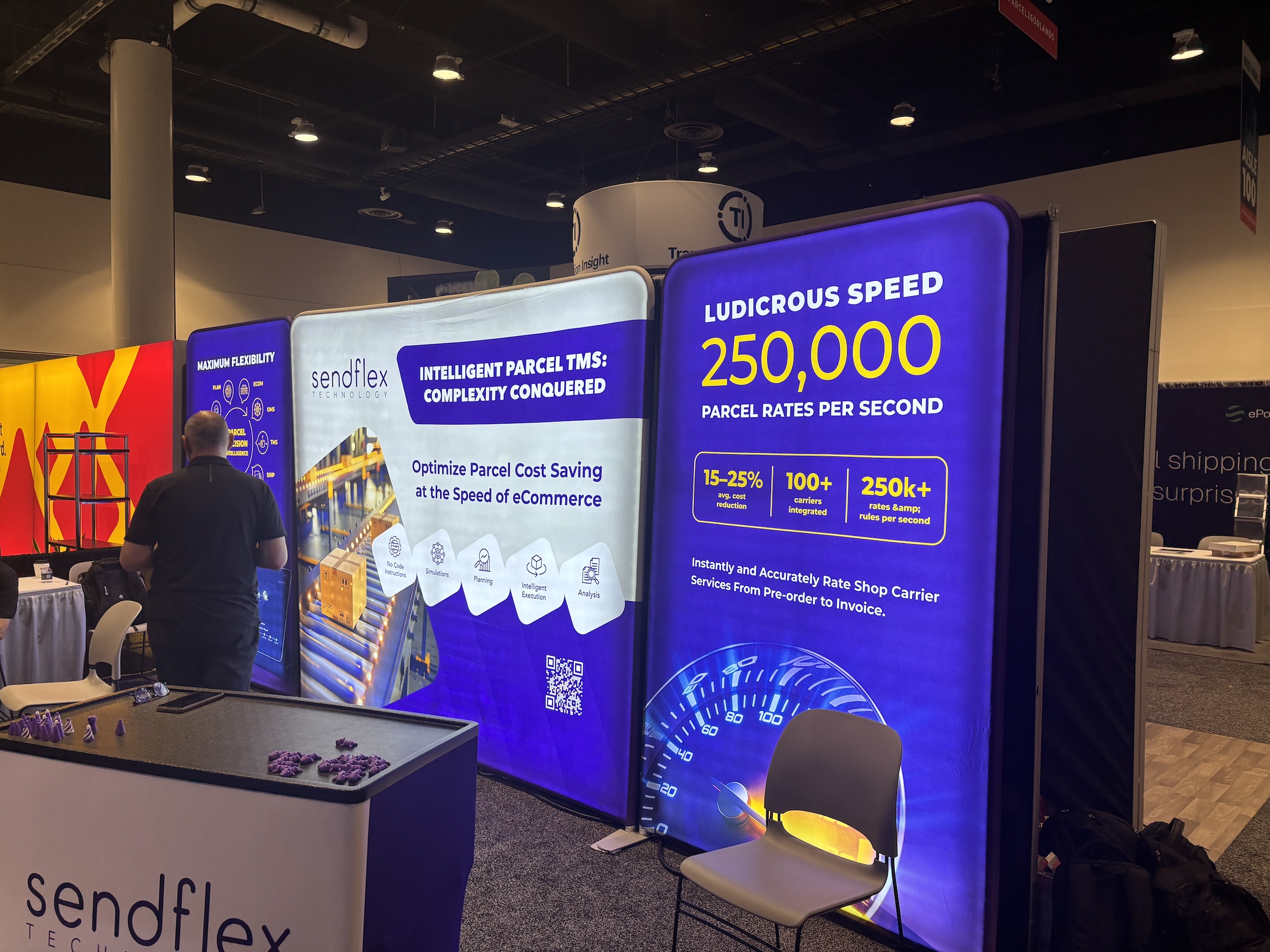
For most of the last two decades, parcel strategy came down to a negotiation with two national carriers, with USPS as the backstop. PARCEL Forum ’26 made it clear that that era is now over.
Over 3 days at the Gaylord Palms in Orlando, speakers from carriers, consultancies, analyst firms, and technology providers described how things are shifting. The U.S. parcel market is breaking into modular network segments: national carriers, regionals, Amazon, gig-based final mile, and zone-skip and air-injection lanes. Shippers now must assemble and manage those segments themselves, shipment by shipment, with far more precision than an annual carrier bid ever required.
There was a consensus that this level of complexity has outgrown spreadsheets and carrier rating APIs. As network options multiply, shippers and 3PLs need AI-driven parcel TMS platforms that can simulate the cost and service impact of a decision before any volume moves.
Here are the five takeaways we brought home from Orlando.
The rate outlook alone is a reason to rethink your carrier mix. The 2027 forecast shared at the show calls for another 5.9% headline GRI. But most of the cost increase is actually in dimensional weight rules, minimum charges, fuel tables, delivery area surcharges, and shifting definitions of additional handling. Those changes never appear in a GRI announcement, but they definitely show up on the invoice.
The market structure has shifted for shippers, too. ShipMatrix figures presented at the show put UPS, FedEx, and USPS at roughly 61% of U.S. parcel volume in 2025, down from about 85% before the pandemic. Amazon alone delivered an estimated 6.7 billion of the 23.9 billion U.S. parcels shipped last year, roughly 28% of the market on its own. Tusk Logistics data showed alternative carriers growing at about 33% a year (compounded) over four years, while legacy carriers contracted 2.4%.
The legacy carriers aren’t fighting to win that volume back. That’s because UPS and FedEx are managing for yield rather than chasing every package. Shippers that stay concentrated with one national carrier will pay more for that loyalty every year.
Key takeaway: Multi-carrier has evolved into multi-carrier network portfolios, and portfolios need models that decide how, when, and where to use each carrier network for a specific order.
Chris Cashin, CEO of Parcel Consulting, cautioned that a regional carrier can look less expensive on a given lane even though it’s costing a shipper elsewhere. Worse, if that shipper diverts enough volume, it can fall out of its primary carrier’s incentive discount tier across the rest of the network.
OnTrac CEO Mike Brown looked at the same problem from the carrier’s side. Giving a carrier only a thin residual slice of volume, he argued, keeps the carrier and the shipper from ever finding better network economics together. Treating diversification as an afterthought shortchanges both sides.
Both warnings lead to the same conclusion: carrier-level averages are the wrong unit of analysis. The decision has to be evaluated at the level of the shipment, the ZIP cluster, or the lane. The strategic question is no longer “which carrier should we use?” It’s now “how should this shipment move through the network we have?”
A single carrier’s rating API can’t answer that. Those APIs were built to rate one package at a time. Answering it takes rating and routing simulations run across a large data set, with real contracts and incentive tiers built into the model. Our CEO Bob Malley made that case in the September/October issue of PARCEL Magazine, in “Parcel Cost Modeling Is the Key to Unlocking Cost-Effective Carrier Diversification.”
Key takeaway: Diversification without upstream modeling and optimization just multiplies guesswork across more carriers.
Alternative carriers no longer need to own a network end to end to offer national reach. They’re now assembling it from parts: zone skipping, contracted air injection, and shared technology that links regional networks together. Orchestration is replacing ownership.
OnTrac described air capacity as an “air truck.” It serves as a lane option in its own right and as a recovery path when a ground trailer misses its move. It’s a creative answer to a real service problem, and it’s another variable in the routing decision.
That’s the tradeoff with middle-mile innovation. Every added lane, hub, and injection point expands the set of paths a package can take, and each path has its own cost, transit time, and failure mode. Multiply that across thousands of orders a day and routing can no longer be managed by hand or with static rules reviewed once a quarter. Instead, it needs to be modeled and simulated.
This also makes carrier monitoring more important. A parcel TMS needs to track what’s actually happening with each carrier’s volume and apply routing rules that keep the shipper on pace to earn its discount tier incentives. The alternative is discovering a missed tier on a quarter-end invoice.
Key takeaway: The more creative the network gets, the more it needs a system that can simulate operational impact before you commit volume.
Speakers applied AI to nearly every network design question on the agenda. Bloomberg Intelligence Senior Analyst Lee Klaskow and Gartner’s Chris Kina opened the show by looking at shifting consumer behavior and how AI and digital twins are reshaping delivery networks.
The tone throughout was noticeably more grounded than a year or two ago. After a stretch in what Gartner calls the trough of disillusionment, businesses are finding practical parcel management uses for AI and pairing them with governance. Modeling came up again and again as one of the most practical. Reveel Chief Customer Officer Michael Falls discussed using integrated parcel data to model tradeoffs before they surface on a carrier invoice.
Our CEO Bob Malley moderated a session on decision intelligence and shipping cost reduction strategies. The panel discussed Gartner’s hybrid AI model, which pairs two kinds of logic, each good at different jobs. Probabilistic AI works well for prediction problems such as estimated delivery dates. It is slow and unreliable when asked to calculate carrier rates. Rate calculation is arithmetic, so it belongs to deterministic logic that applies contract terms, surcharges, and accessorials exactly the same way every time. A practical architecture uses each type of logic where it’s strongest.
Key takeaway: Businesses are moving past AI pilots. They’re becoming more practical about where AI fits and why governance matters, and parcel network modeling across large data sets is an ideal use.
Label printing answers one question: How do I get this package out the door today, fast? It’s important, but it’s become table stakes in the modern age. If your strategy centers on label printing, you’re losing margin even faster.
Modeling answers the question that controls margin: Which network should this package move through this week, given current rules, rates, and delivery promises, without triggering an unexpected surcharge?
Every trend from Orlando adds variables a shipper has to weigh on every package: the fracturing of the carrier oligopoly, yield management by legacy carriers, the risks of careless diversification, middle-mile orchestration, and pricing complexity hidden in surcharges. Manual processes and legacy shipping software can’t scale to that, but modeling can.
That’s the problem the Sendflex platform solves. Sendflex processes more than a million parcel rating and routing rules per second, so teams can run unlimited “what-if” simulations on their own order, shipment, and invoice data. What they learn doesn’t sit in a report. It becomes rating and routing rules applied in the shopping cart, during order allocation, and through fulfillment and shipping. PARCEL Forum ’26 made clear that the whole industry now needs this capability.
Carriers have been changing the game in recent months, but most shippers are still using the same old tools. There’s a huge opportunity when shippers close that gap.
The shippers and 3PLs who close it will treat their carrier mix as a portfolio, evaluate it shipment by shipment and lane by lane, and model decisions before volume moves. Those who don’t will keep learning what their network cost them one invoice at a time.
Ready to see what modeling does to your parcel spend? Request a demo.