A response to Esther Fung's Wall Street Journal piece: "We Got Hooked on Fast Free Shipping. Now Retailers Are Taking It Away"
If you haven't read Esther Fung's recent Wall Street Journal article, it's a must. The piece draws a clear line in the sand: the era of "free" shipping that Amazon conditioned us all to expect is quietly, but decisively, coming to an end.
And the numbers back it up.
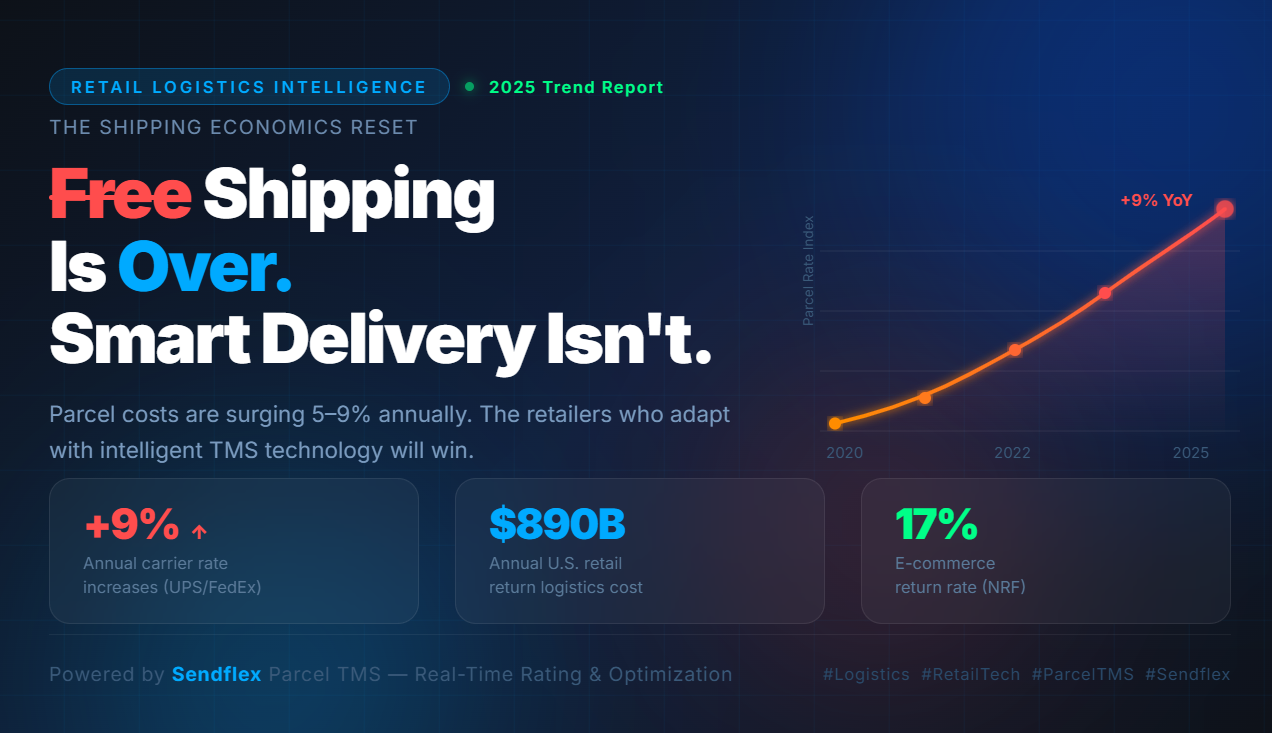
Shipping costs have been ballooning for years, but retailers absorbed the pain to stay competitive. That calculus no longer works:
As Fung's article makes clear, consumers are starting to feel it. The honeymoon is over. With the negative impact on retailer margins, something’s gotta give.
So where does this leave retailers? Stuck between two forces:
The retailers who will win in this environment aren't the ones who simply slap on a shipping fee on checkout and call it a day. They're the ones who use intelligent parcel logistics technology to make smarter, faster, and more profitable decisions — at the moment of purchase.
This is exactly where parcel Transportation Management Systems (TMS) like Sendflex come in.
Parcel TMS technology has come a long way from simply printing labels at the end of a conveyor. AI-driven parcel TMS platforms like Sendflex enable retailers to execute real-time, high-speed rating across every carrier, service level, and lane simultaneously — in milliseconds, at the point of checkout.
Here's why that matters in today's environment:
Not every order needs two-day delivery. A customer ordering a non-urgent household item in the same region as your fulfillment center may be perfectly happy with 4-5 day ground shipping — if you give them the choice. Sendflex's optimization rules engine can automatically identify when standard shipping is the most cost-effective option and present it to the customer accordingly, reserving premium service spend for orders where it actually drives loyalty.
This is the nuanced opportunity most retailers miss. With the right routing rules in place, a parcel TMS can evaluate multiple factors simultaneously:
Armed with this data at checkout speed, retailers can present a dynamically-priced express upgrade "Get it by Thursday for just $4.99 more" that converts because it's relevant, fair, and timely. The customer pays for what they value. The retailer captures margin instead of subsidizing it.
Sendflex's optimization engine can enforce business rules that redirect shipments to the lowest-cost compliant carrier and service level meeting the delivery promise automatically — without manual intervention. That means a retailer processing 50,000 orders a day isn't paying UPS Ground rates on a package that USPS Ground Advantage would deliver just as effectively at a fraction of the cost.
Fung's article is a wake-up call, but it's also an opportunity. Retailers who treat the end of free shipping as a crisis will lose customers. Retailers who treat it as an optimization opportunity with the right technology in their stack will come out ahead.
The economics or parcel shipping has changed. The retailers who survive and thrive will be the ones who change with it, using high-speed intelligence to make every shipping decision smarter than the last.