Explore the hidden variables that eat away at retail profits and learn how Sendflex’s Parcel TMS offers the tools to control shipping costs, optimize order fulfillment, and safeguard retail margins in today’s competitive market.
Uncontrolled parcel shipping costs are a massive threat to B2C retailers' already tight margins. With the rise of eCommerce, retailers have raced to adopt omni-channel fulfillment strategies to stay competitive, particularly against marketplace giants like Amazon, who have moved inventory closer to consumers for faster and free delivery. But final mile costs continue to surge, climbing at rates that far outpace inflation. This growing financial burden is pushing online retailers to rethink how they manage parcel shipping costs to protect their profitability.
To stay ahead, companies need to move beyond traditional shipping practices and embrace more advanced strategies to safeguard their margins. In this article, we’ll examine the challenges driving up parcel costs, identify which retailers are feeling the pinch the most, and explore how modern solutions like Sendflex help companies regain control and keep their bottom lines intact.
The financial landscape for B2C retailers is becoming increasingly challenging as parcel shipping costs skyrocket. In 2024, major carriers UPS and FedEx announced general rate increases (GRIs) of 5.9%, significantly outpacing the U.S. inflation rate of 2.9%. However, a deeper analysis by Reveel found that most shippers will experience actual rate increases that exceed GRIs, closer to 8% in many cases, and easily into the double digits for retailers that ship oversized packages or products that require special handling.
For further context, that puts the projected ground parcel rate for this year at least 28.9% above the January 2018 baseline. This spike is particularly concerning as it occurs despite a market where carrier capacity is abundant. Instead of leveraging available capacity to offer more competitive rates, major players have chosen to implement further rate increases.
Beyond standard rate increases, businesses are struggling to absorb or even predict the proliferation of surcharges and special service fees. The gap between expected shipping costs and actual carrier invoice amounts is widening, leading to unexpected financial burdens. Understanding these parcel surcharges and fees is crucial for calculating shipping costs and protecting margins in today’s challenging environment. Here are some of the major culprits in the widening expected vs. actual shipping cost gap:
In addition to unexpected surcharges and fees, primary carrier contracts incorporate incentive discount tiers that are difficult to monitor and control. Fear of losing discounts is a reason many shippers avoid parcel carrier diversification. Without careful planning, loss of primary carrier discounts and unexpected surcharges can quickly erode margins and threaten profitability.
In today’s eCommerce environment, consumer expectations for free shipping are at an all-time high. With 50.6% of online shoppers ranking free delivery as their top purchase driver, offering this perk is a significant advantage. To further reinforce this point, 48% of U.S. consumers cite extra costs—like shipping, taxes, and fees—as the primary reason for abandoning their shopping carts.
So long as free shipping remains an eCommerce standard, it is essential for merchants to accurately estimate and factor shipping costs into their product margins. But the gap between what shippers expect to pay and what they actually incur is growing wider. In addition to unexpected surcharges and floating carrier discount tiers, uncertainties related to inventory location, SKU attributes, and unknown carton sizes make it difficult to predict final shipping costs.
Legacy shipping systems don’t address the margin issue. They focus on throughput, primarily printing labels for multiple carriers during shipping execution rather than shipping cost containment. Besides, shipping cost optimization needs to occur further upstream from shipping execution during order creation and allocation.
Traditional WMS and OMS also focus on efficient fulfillment and ignore some of the transportation cost-effective factors that can increase shipping expenses. For example, controlling how cartons are packed during the fulfillment process can significantly reduce unexpected dimensional weight adjustments and oversize fees and prevent customers from having to haul away excess corrugate to landfills.
To close this gap, retailers need more sophisticated tools that can accurately calculate and manage shipping costs at every stage of the fulfillment process. Without this, the promise of free shipping could quickly turn from a competitive edge into a financial burden.
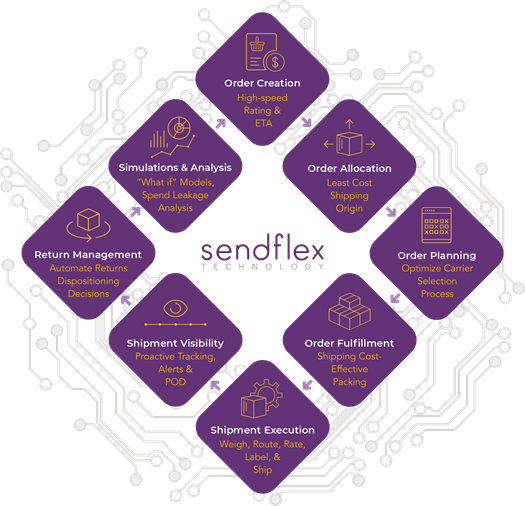
In an environment where legacy multi-carrier shipping systems focus on printing carrier labels quickly, Sendflex’s Parcel TMS platform goes further. In addition to automating shipment processing, Sendflex automates accurate shipping cost calculations and optimizes decision-making processes upstream, effectively reducing margin erosion at every stage of the order-to-delivery process and beyond.
Sendflex also offers powerful simulation capabilities that allow retailers to forecast and refine their shipping strategies before execution. These tools enable users to model different scenarios and test various shipping routes, carriers, and service levels to identify the most cost-effective options. By simulating potential outcomes, retailers can gain a deeper understanding of their shipping expenses and make data-driven decisions that prevent unexpected cost overruns. This approach helps to close the gap between estimated and actual costs and empowers retailers to safeguard their margins in an ever-changing market.
Controlling parcel shipping costs is crucial for maintaining profitability. With Sendflex, retailers have the tools they need to manage these costs effectively and protect their margins. Contact the experts at Sendflex for a consultation and demo to see how their Parcel TMS can transform your shipping operations.