
Carriers, services, and surcharges multiply every year. Yet most shippers still wait on IT or consultants for hard-coded programming to keep up.
Every week a change sits in that queue is a week of cost and service you can’t get back.
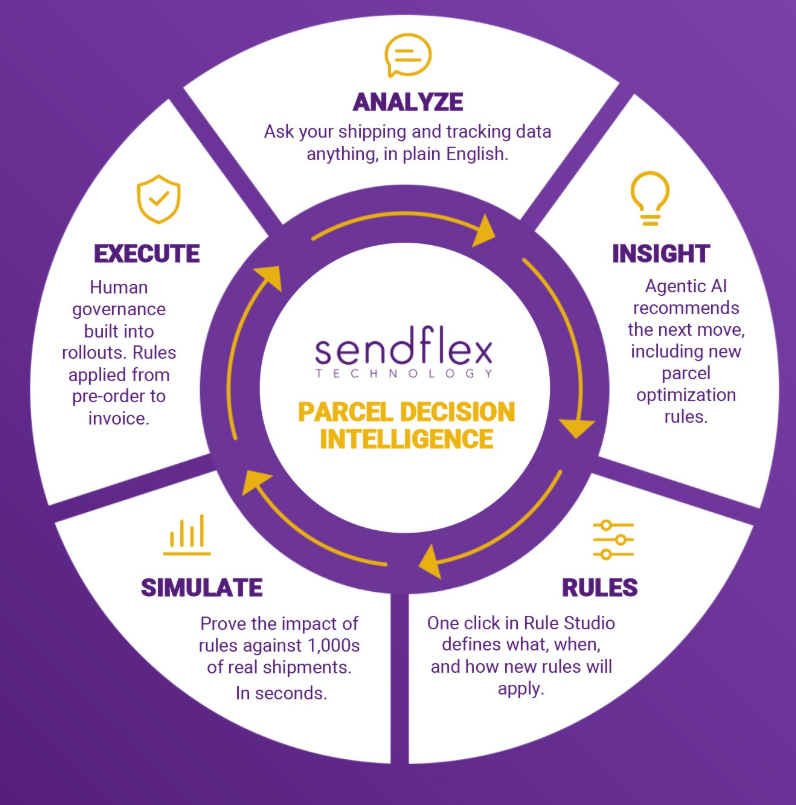
The people who manage parcel shipping every day should have the self-service tools they need to adapt to change, continuously reduce costs, and improve delivery performance. That’s why we built Sendflex Parcel Decision Intelligence. One closed loop, run by your shipping team, in five steps: Analyze, Insight, Rules, Simulate, and Execute.
Here’s how the five steps work together in practice.
Ask your shipping data anything. Get reasoned answers back.
Sendflex’s Analyze module answers your plain-English questions with clear explanations and data visualizations. Our AI agents continuously review your shipping and tracking history, in the context of your current configuration and rules, for patterns, anomalies, and operational performance across your enterprise. They add context, point to the cause behind a problem, and show the evidence.
That context is what makes the difference. AI chat on a dashboard can describe your data, and agents connected to your decision engine can see the rules and configuration behind every result.
Your team asks questions like these:
There’s no SQL required, and you don’t have to wait on analysts. Best of all, you no longer have to deal with canned dashboards or reports about last quarter’s problems.
Prefer not to ask? Sendflex constantly monitors your current state and delivers scheduled, role-specific briefings by email, so each person gets the data they need to make smarter decisions.
Analyze also fits your AI governance strategy. It supports MCP, so you can bring your own AI model to work with our agents and keep your guardrails intact.
But understanding a problem is only half the job. The real question is what to do about it.
Diagnose issues. Prescribe solutions.
“Consider diversifying carriers” may be sage advice, but these days it isn’t good enough. You need to know how, when, and where to use services effectively.
While most AI in shipping software stops at an answer, ours ends in an executable rule. Analyze diagnoses the problem, and our AI agents suggest the fix as a specific rule you can act on. For example:
“Route residential shipments between 1 and 5 pounds from your Reno facility to an alternate carrier for specific ZIP codes, because the data shows lower total cost with equal or better on-time performance. Would you like me to create that rule?”
Every recommendation comes with its evidence, so your team can understand impact and context before changing anything.
And your team does the deciding. Nothing is saved or deployed without a person’s approval. AI recommends, but your team must approve.
Insight fits your AI governance, too, so you can avoid vendor lock-in.
Create or modify rules in minutes, instead of days.
Legacy shipping systems require hard-coded programming. With Sendflex’s Rule Studio, one click turns a recommendation into a working rule. Your team can refine what a rule applies to, when it applies, and how it applies. Everything’s no-code, so you can skip IT tickets and consultant engagements.
Rules are described in plain English. They can automate decisions based on almost anything about an order, SKU, shipment, customer, location, or carrier contract, then change how the shipment is packed, rated, routed, shipped, or returned. A few examples:
A rule can do far more than allow or block a carrier. It can re-rank services, apply markups or discounts, add accessorials, adjust dates, switch ship-from locations, and change how an order is cartonized. Rule Studio decides which carrier wins rather than just which ones are allowed.
Add conditional logic and lookup tables. Layer and sequence rules by client, location, season, and carrier commitment. Schedule them differently for peak and promotions. Chain them so later rules build on what earlier rules decided.
Visual editors and process maps show the logic step by step, so the people who set your parcel policy can review and refine it themselves. That’s how National Ropers Supply makes rule changes in minutes rather than weeks.
A rule is only as good as your confidence in it. How do you know what it will actually do when it touches a live shipment?
Trust but verify. At ludicrous speed.
Before a single package is affected, Sendflex runs your new rule, even one that isn’t live yet, against your shipping and tracking history. You immediately see the cost impact per shipment and in total, plus carrier ranking, delivery times, and service level outcomes.
Legacy and Excel-based simulations can take days for an analyst, vendor, or Python programmer to set up. Then hours to run. If you want to make an adjustment, it takes more time and costs more.
Sendflex’s optimization engine processes 1,000,000+ rates and rules per second. That means you can run simulation models against months of shipments in seconds. Adjust a rule, a tolerance, or a ship-from origin and rerun it.
This is where AI in the engine pays off. A language model can predict a plausible rate. Our deterministic engine calculates your exact contract rate, with every surcharge and minimum applied. When money changes hands on every package, plausible isn’t good enough.
Our Rate & Route Manager and Dynamic Rate Modeling Whiteboard let you adjust carrier rate cards and instantly visualize the cost and delivery impact.
Implement with confidence (not crossed fingers).
Even a rule proven with extensive simulations needs a safe way to go live. Most systems give you an on/off switch. Sendflex gives you granular controls across the entire fulfillment lifecycle, from pre-order to fulfillment to shipping to returns and invoicing.
In Rule Studio, move your rule from Draft to Controlled, where it applies to a percentage of shipments at the ship-from locations you choose. Go Live only when you’re completely confident in the outcomes. You can pause anytime.
Want additional guardrails? Shadow Mode runs a rule alongside your current policies and logs what it would have done, while live shipments stay untouched. You get the evidence without the risk.
In production, every shipment carries an audit record: which rule versions ran, what was evaluated, what changed, and whether it was in the rollout. Why was this service preferred? Why was that option excluded? Which rule changed this shipment? Ask in plain English and get the answer.
Every rule change is also a new version, with full history, restore, and a record of who changed what and when.
Shipping execution and tracking records feed straight back into Analyze, so you can see whether the rollout is working as expected. You can clearly see the cost per shipment, delivery performance, and outcome details. Then the continuous improvement loop starts again.
That’s the difference between a static dashboard that simply points at a problem and a process that continuously improves results, with proof in hand. “Actionable insights” should have meant more than a dashboard. Now it does.
Hybrid intelligence: AI agents that recommend, and a deterministic optimization engine that executes accurately every time. And because Sendflex supports bring your own model, it all runs under your corporate AI governance.
AI inside rather than on top.
Sendflex started with a high-speed, self-service optimization engine that applies rules and compares configurable rates across the order-to-invoice process. The bottleneck was never the engine. It was people finding the right problems to solve and configuring the fix.
Our AI agents close that gap. They monitor shipping activity, spot the opportunity, and write rules in plain English. The engine proves them against your real shipments in seconds, and your team approves the rollout.
We added AI chat to a dashboard, but we went much further by building agents into an engine that already evaluates 1,000,000+ rates and rules per second. The agents propose, the engine proves, and your team approves.
Plenty of shipping platforms now describe themselves as AI-powered. Check that claim by asking five questions that help separate AI that changes outcomes from AI that answers questions.
Does the AI’s recommendation become an executable rule, or end as a chat answer? An answer, however smart, still leaves your team to build, test, and deploy the fix.
Can you test it against your own shipping history before it goes live? Tracing one sample shipment, or counting how many orders a rule would have matched, isn’t the same as seeing the dollar impact across months of real volume.
Is every rate calculated by a deterministic engine, or “predicted” by a language model? Contract rates carry tiers, minimums, surcharges, and DIM rules. A predicted rate is an estimate, but a calculated rate is what you’ll be billed.
Is every AI-suggested change versioned, phased, and audited on each shipment? An on/off switch isn’t a rollout plan. Look for version history, restore, controlled rollouts by location and percentage, and a record of why each shipment went the way it did.
Do execution results flow back, so you can see whether the recommendation worked? If they don’t, every decision starts from scratch.
Plenty of tools help shippers understand their problems. Parcel Decision Intelligence is designed for the people who are accountable for fixing them.
Bring us a carrier commitment, a customer requirement, or a shipping policy you want to improve. Talk to our team and let’s see how your team could put it into operation.