For years, our industry has promised “actionable insights.” Most of the time, what shippers actually got was a dashboard.
Dashboards are good at telling you what happened. They are not good at telling you what you should do about it. A logistics manager spots a cost spike, exports the data, builds a spreadsheet, debates it in multiple meetings, then files a change request with IT or a software vendor, and hopes the hard-coded rule doesn’t break something on Monday morning in production. By the time the change request is tested and live, the requirements have moved on. Because change is now a constant in our industry.
Now AI is being deployed to automate shipping decisions. But without guardrails, one bad rule can erode margins across thousands of shipments before anyone notices.
The gap between insight and action is where shipping spend leaks occur. While AI can now automate shipping decisions in seconds, without guardrails, it can erode margins just as fast.
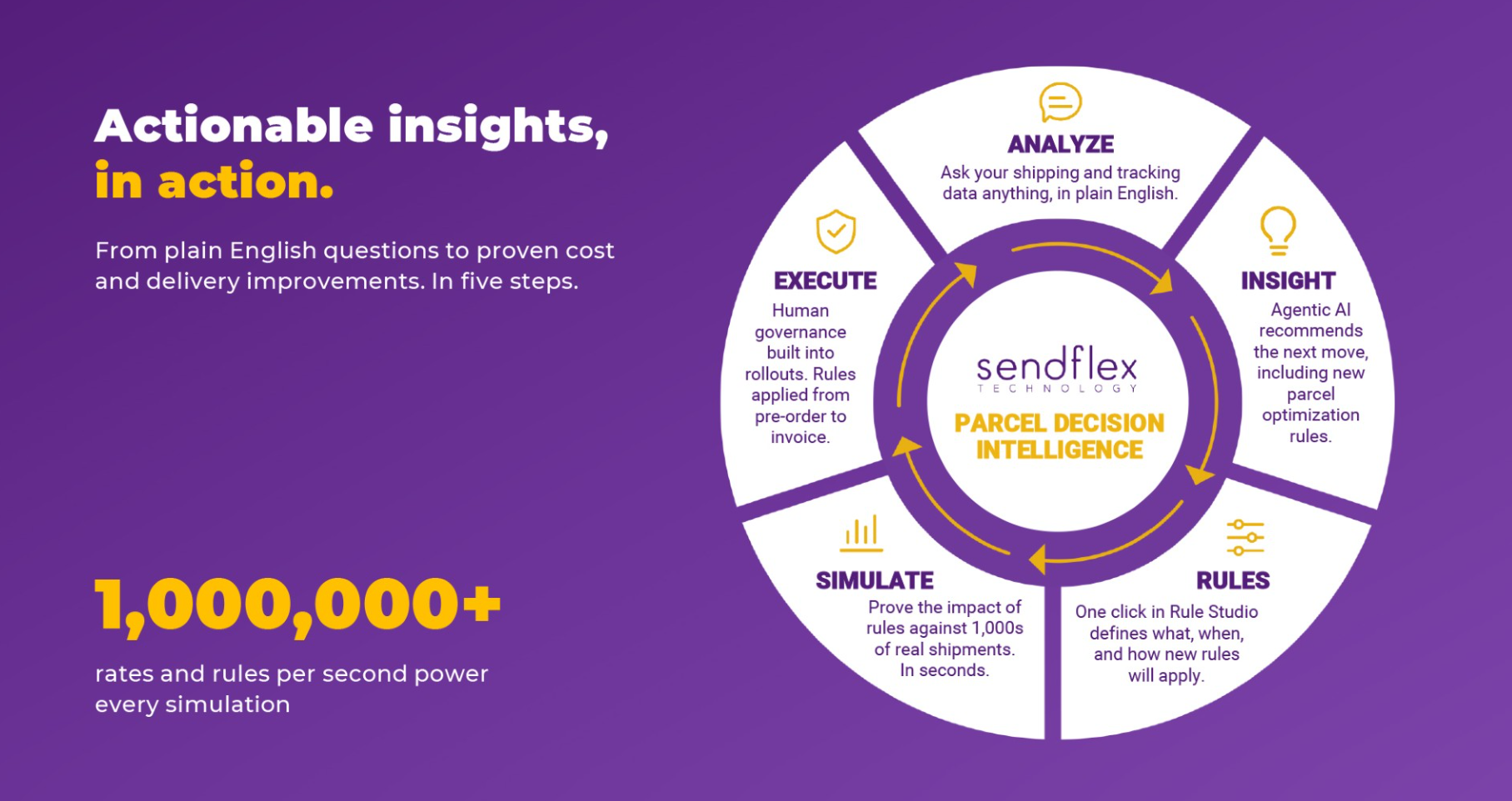
At Sendflex, we engineered our Parcel TMS platform to close that gap. Our parcel decision intelligence framework uses agentic AI to turn insights into business rules, simulate potential impact, and help teams control deployment, while auditing costs and operational performance. Cumulative data then informs the next decision, with guardrails in the hands of managers accountable for results.
With Sendflex chat capabilities, logistics managers ask questions of their shipping and tracking data in plain language and get precise answers back instantly. Clear explanations and visualizations help your team understand the findings.
No SQL. No waiting on analysts or programmers. No static reports that address last quarter’s problems. You get the insight you need, when you need it.
This is where Sendflex goes further. Using MCP, we support a “bring your own AI model” that works with our AI agents to go beyond simply describing your shipping data. It reviews your shipping patterns, applies reasoning based on context, and recommends specific actions to reduce costs, improve operational performance, and keep your on-time delivery promises.
That includes recommending specific parcel optimization rules, like carrier selection criteria. Not vague advice like “consider diversifying carriers,” but a concrete rule you can act on. For example: route residential shipments between 1 to 5 pounds from a given facility to an alternate carrier for specific zip codes, because the data shows a lower total cost with equal or better on time performance.
Every rule recommendation links directly into Sendflex’s Rule Studio. In one click, your team defines what, when, and how a new rule will apply, with no code required. Rule Studio combines shipment information with custom running totals, calculated fields, and lookup tables. Multiple decisions and actions can work together in one rule.
Purpose-built visual editors make the intent clear. Routing guides and lookup tables define eligible choices. Process maps help you visualize and walk through rule sequences step by step. Shipping constraints, preferences, and ranking rules influence preference among eligible options, while rating rules alter cost calculation results. Other actions modify shipment dates, avoid costly accessorials, or transform shipment data. Shared conditions and advanced configuration support more complex policies.
Most importantly, executives who formulate parcel logistics policies can review the rules and easily make adjustments and refinements that enforce carrier contract tier commitments, service requirements, and priorities. No costly programming. No long development cycles.
But here is the part that changes the game. Before a single package is affected in production, you can test rules against individual shipments or months of historical shipping transactions.
Sendflex’s in-platform optimization engine processes 1 million contract carrier rates and rules per second, making it the perfect tool to generate “digital twins”. The engine is a single source of rating truth that can be used to rerun months of real shipping history and apply proposed rules to determine impact in seconds, including cost per package, carrier mix, transit performance, and service level outcomes. No more guessing about the impact a change will have. Our simulation model accurately determines outcomes based on your actual network and carrier contract rates, mitigating risks of what might happen in production.
Proven rules are then staged for controlled implementation with human governance built in. Approvals, phased rollouts, and oversight stay in the hands of your team. AI recommends. But your people decide. Every change is deliberate and accountable because all decision results are logged and stored with each shipment.
You can use Sendflex’s “Shadow Mode” feature as an extra set of risk mitigation guardrails. You can run the candidate rule in production, while current rules keep running, leaving the live shipment untouched. Sendflex logs and stores Shadow Mode results as evidence for further review.
Once approved, rules can be rolled out in a controlled fashion, gradually widening usage on your terms across the full fulfillment lifecycle, from pre-order to order allocation to fulfillment planning to shipping execution to returns and invoicing. Shipment-level execution records let users inspect which rule versions ran, what was evaluated, and what changes were recorded.
Version history and audit records show how the policy was changed over time. Important questions get answered in clear, natural language. Why was a service preferred? Why was an option excluded? Which rule changed this shipment? Teams can investigate individual decisions described in plain English, then return to Analyze to examine broader outcomes and further refine their carrier management policies.
Best of all, Sendflex’s BYOM approach ensures that our AI agents operate under the auspices of corporate AI governance, thereby giving organizations more control, flexibility, and cost efficiency in AI and technology adoption while avoiding vendor lock-in.
Put it together and you get something the parcel industry hasn’t had before: a closed loop that takes a shipper from a question to a proven, governed operational change, all in one platform.
That is what “actionable insights” should have meant all along. Not a dashboard that simply points at a problem, but a pathway to solve it, with proof in hand. Diagnose and cure.
Shippers are under pressure from every direction. Carrier rates and surcharges used to change annually. Increases and changes now occur throughout the year. Budget predictability, carrier diversification, and faster order cycle times top the priority list for shipping leaders. Executives now realize the importance of agility and control. Every one of those goals depends on making better carrier decisions, faster, with confidence that they’ll hold up in the real world.
Sendflex was recognized in Gartner’s 2026 Market Guide for Multicarrier Parcel Management Solutions, and this release reflects what we believe the next generation of parcel TMS must deliver: intelligence that doesn’t just inform decisions but executes them responsibly.
After 35 years in the parcel software industry, I’ve seen plenty of tools that help shippers understand their problems. This is the first time I’ve seen a parcel management platform that takes you all the way from understanding insight to action and then proves the result before you commit to production.
That is actionable insights, in action.
Bring us a carrier commitment, a customer requirement, or a shipping policy you want to improve. Let’s explore how your team could put it into operation with Sendflex.